

Sensing across the
Humanities, Sciences and Arts
Recap of the second Day of the OLFAC Symposium at the ifk, Vienna
DAY 2 – politics permeate
Day 2 of our recent symposium opened with two contributions from colleagues inside the OLFAC project, each expanding the conceptual terrain of olfaction through distinct culture-historical and artistic lenses.
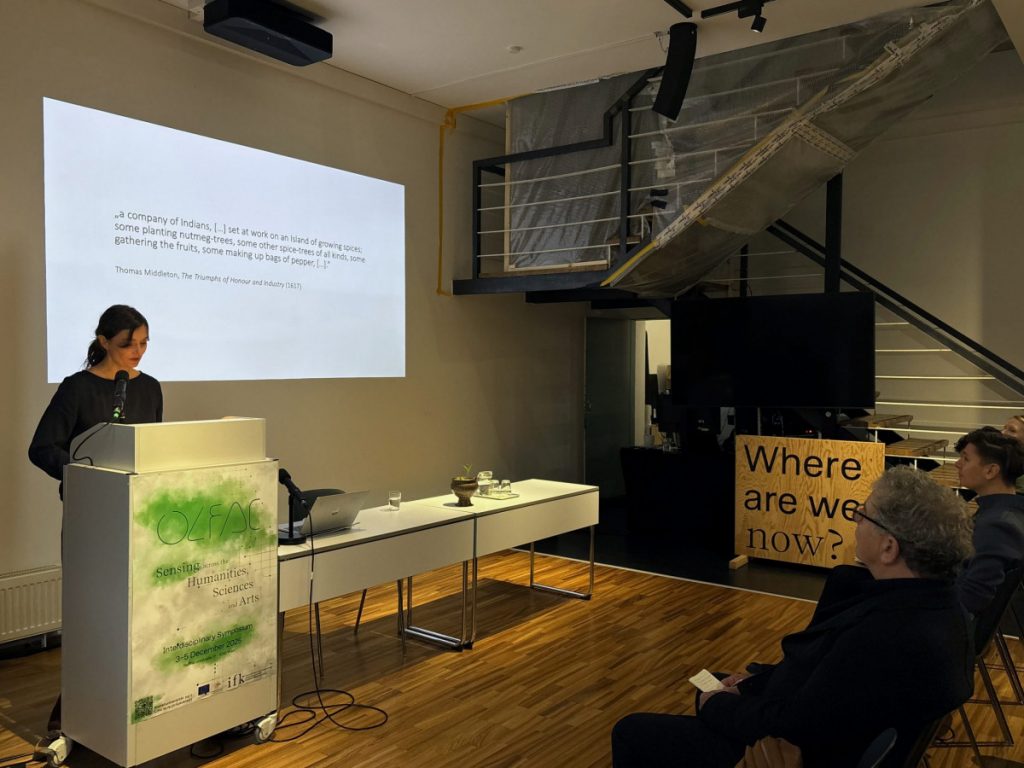
The morning began with Julia Ostwald, whose lecture Odours and Motion: Reflections on the Kinetics of Smell traced the long, intertwined histories of movement, power, and scent. Julia offered a reference-rich journey into early modern Europe—evoking the fragrant pageantry of Lord Mayor’s Shows, the spice-saturated atmospheres of trade routes, and the choreographing of bodies within emergent capitalist modernity. She then brought these historical dynamics into conversation with contemporary choreography, examining how artists such as Faye Driscoll explore the volatility of smell alongside the instability of bodies in motion.
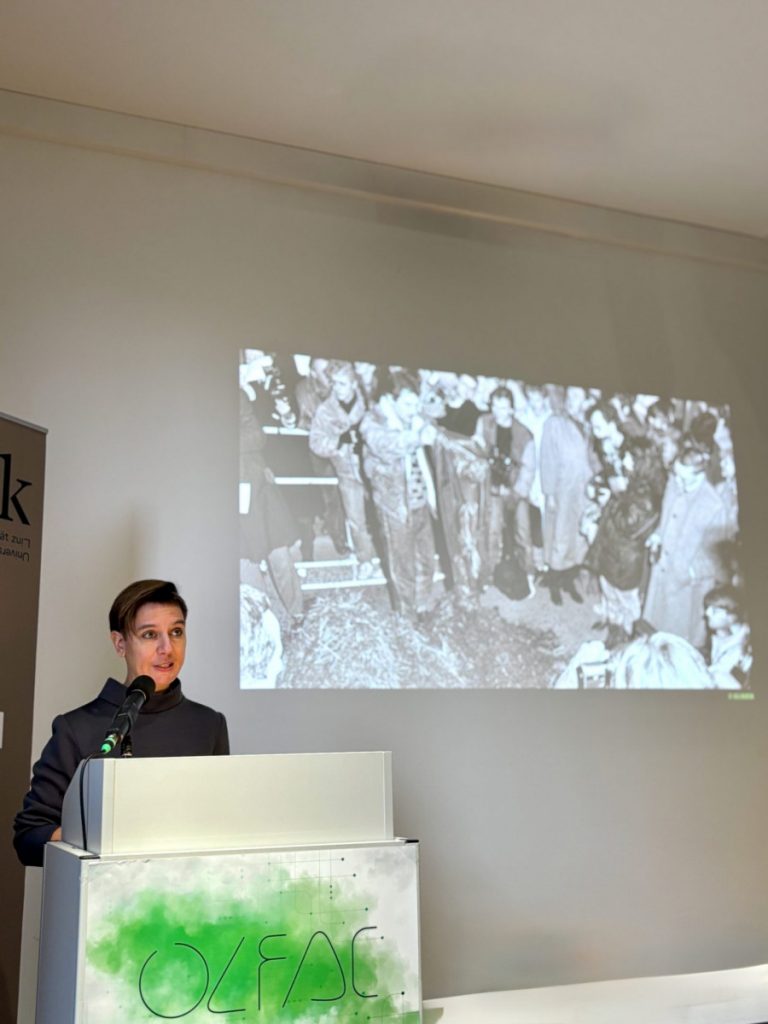
In her lecture Grosse Merde! Capturing the Performativity of C9H9N, Silke Felber brought a cultural lens to the molecular. Silke examined skatole—the compound responsible for both the allure of jasmine and the pungency of excrement—as a cultural and performative agent operating between attraction and revulsion. Drawing on predictive-processing models in cognitive science, she argued smell does not only operate through chemical processes but also through expectation, cultural coding, and affective disposition. Silke’s contribution, moving across theatre history, colonial fragrance discourses, and Austrian contemporary theatre history, demonstrated how skatole molecules traverse registers of seduction, disgust, and productivity; and invited us to think through the affective economies that bind together bodies, species, and environments.
The late morning belonged to Gwenn-Aël Lynn (Chicago), whose lecture-performance Contested Space emerged from field research in South Texas near the SpaceX launch site. Appearing in a hybrid mode—part researcher, part astronaut—Gwenn spoke of sensory deprivation in space travel and the political imaginaries attached to extraterrestrial colonisation.
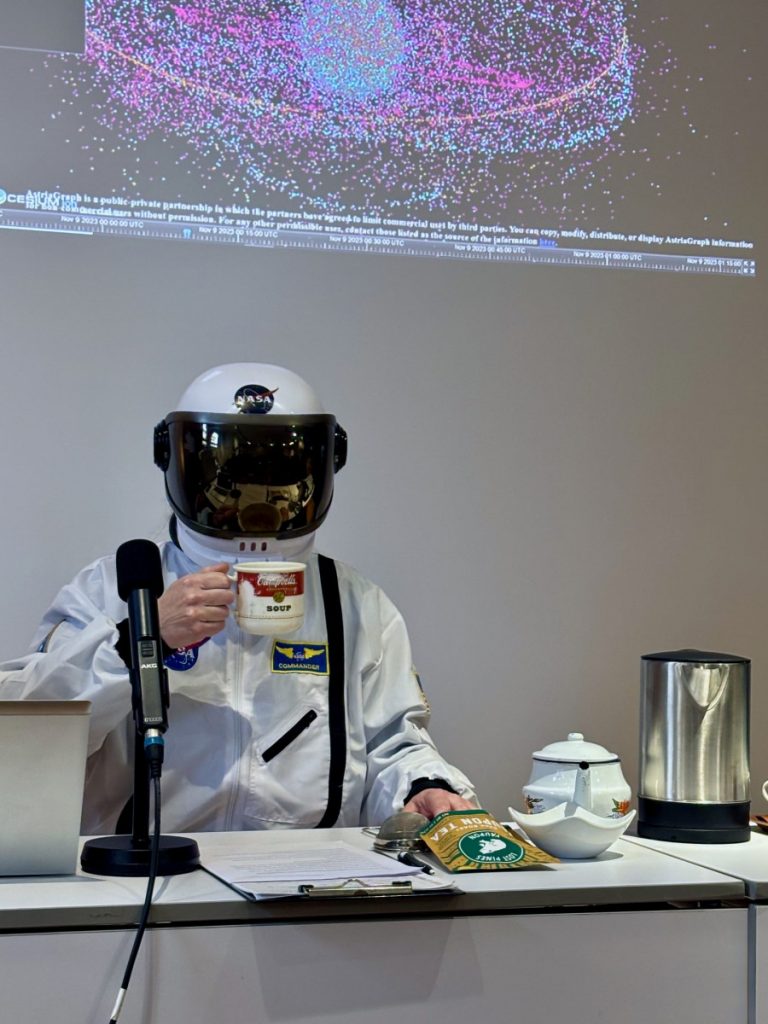
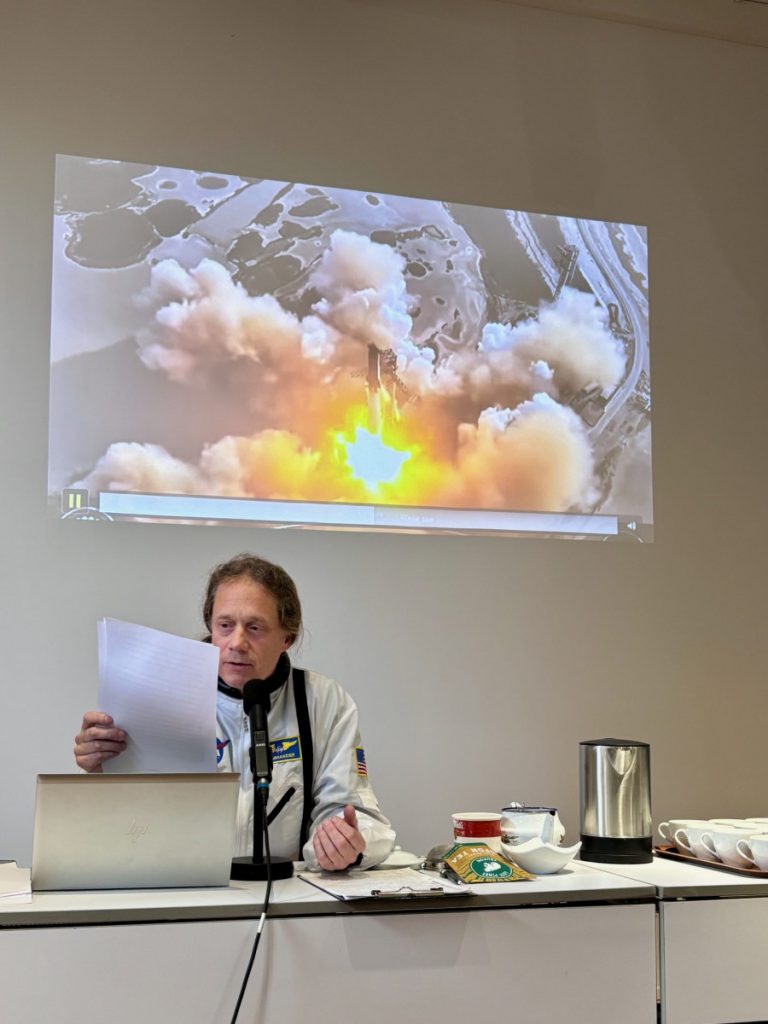
He wove together environmental activism, olfactory fieldwork, and speculative futures to ask what becomes of human and more-than-human sensoria under conditions where breathable atmospheres—and thus the possibility of smell—are stripped away. His work offered a sharp reminder that struggles over land, air, and extraction extend far beyond Earth’s surface.
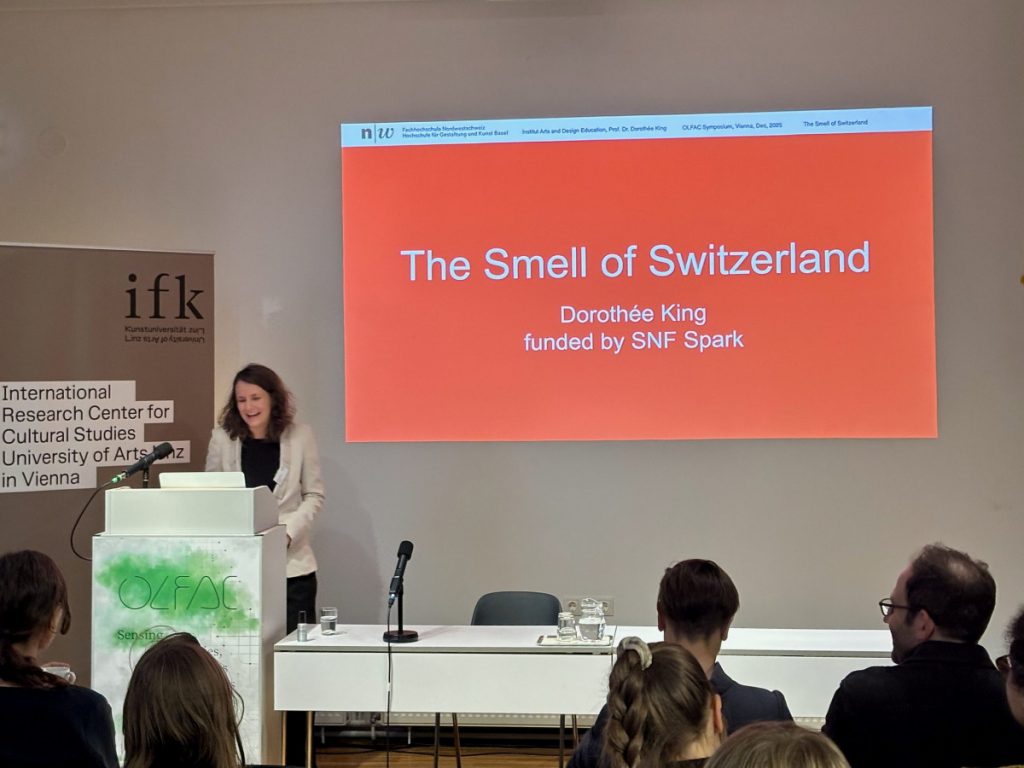
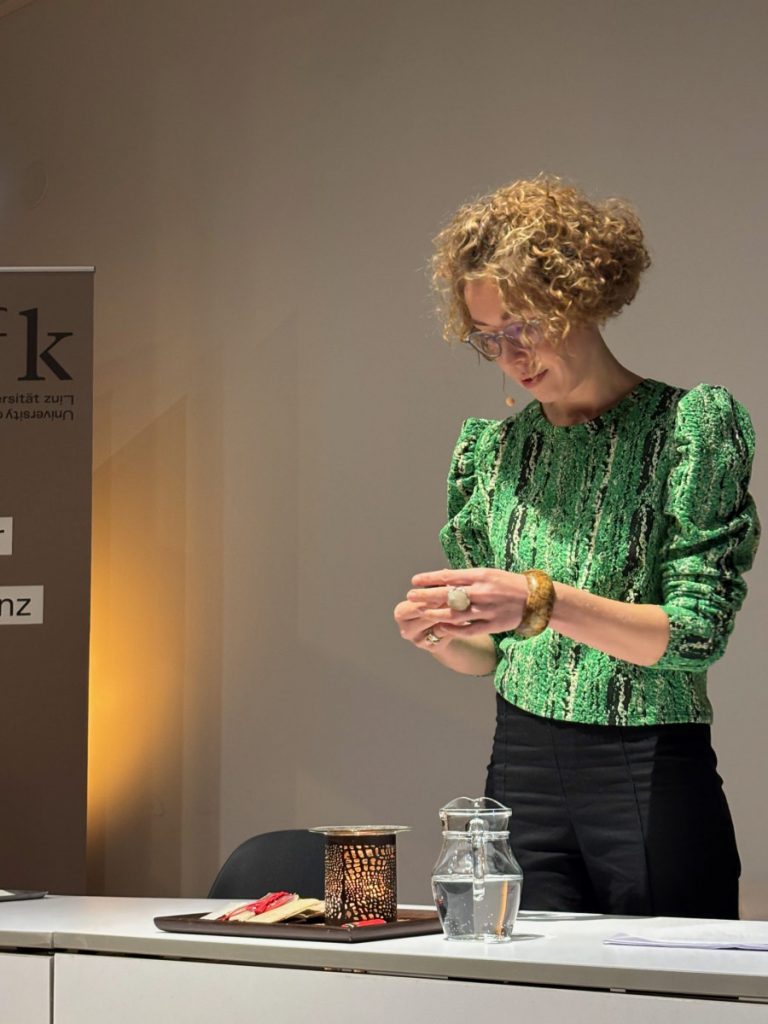
After lunch, Dorothée King (Basel) presented insights into Current Smells of Switzerland, an investigation into the cultivation and manipulation of localised smellscapes. In this project, Dorothée explores how alpine freshness and coziness have been mobilised as a modes of national branding—often through mechanisms of exclusion—and how olfactory signifiers participate in contested debates around belonging, immigration, and identity. She also introduced multisensory artistic practices that challenge these narratives, prompting reflections on what she called “the justice implications of smell.”
In the following lecture, OLFAC team member Freda Fiala presented Camphor’s Crossings: Extractive Histories and Memory Cultures. Freda traced camphor’s sharp, medicinal scent across centuries of colonial governance, trade and socialtransformation in Taiwan. Drawing on fieldwork in Taiwan across museums and heritage sites, archival work, and contemporary artistic projects, she examined how camphor persists as both material and mnemonic—carrying the afterlives of Indigenous dispossession, labour regimes, and transmodern industrial expansion.
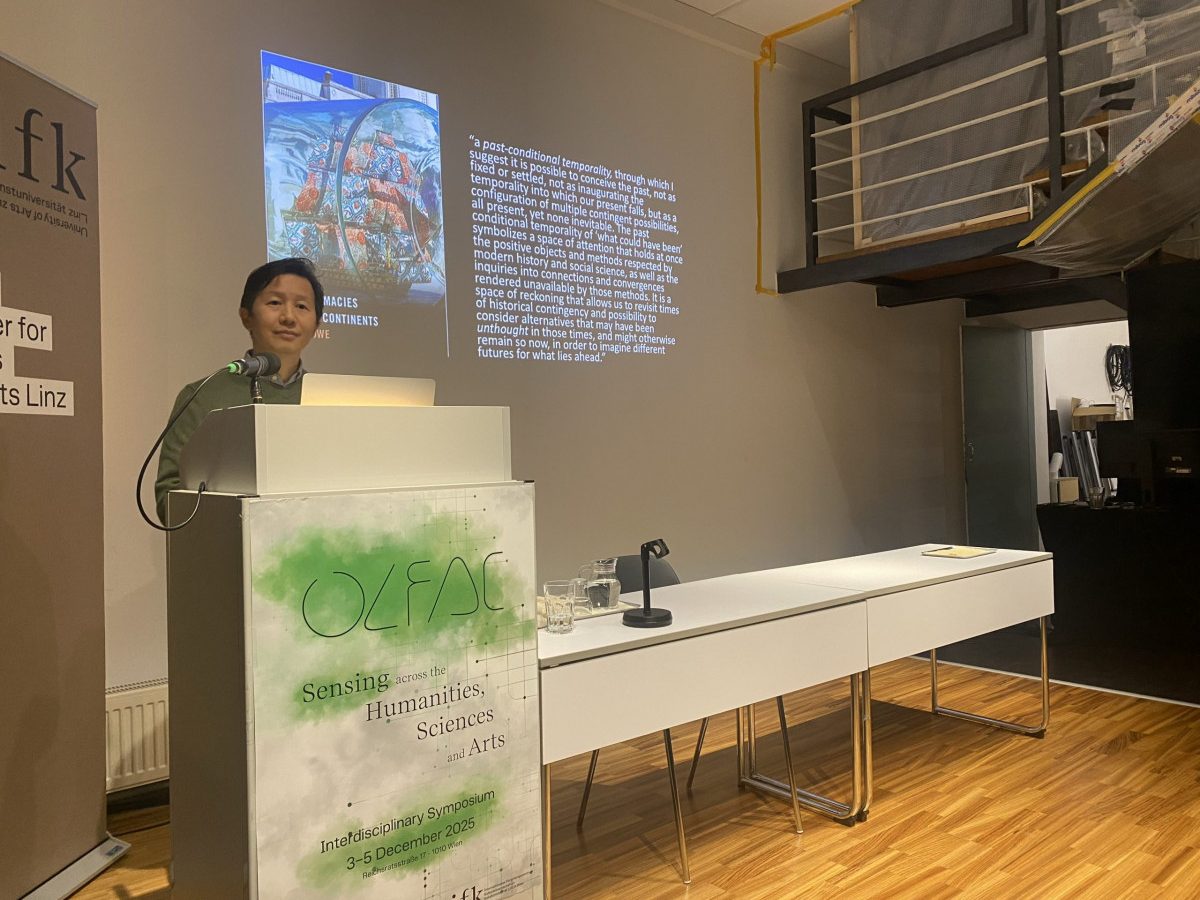
The afternoon continued with Hsuan L. Hsu (Davis) and his lecture Olfactory Ecologies in the Past Conditional. Moving from Marcel Proust to Candice Lin, from the circulation of dried shrimp to the atmospheres of settler-colonialism, Hsuan once again shared a compelling approach for understanding smell as a site where suppressed relations persist. He drew attention to the “past conditional”—histories that might have unfolded otherwise—and asked how olfactory ecologies can help us sense possibilities that were foreclosed by colonial and capitalist worldmaking.
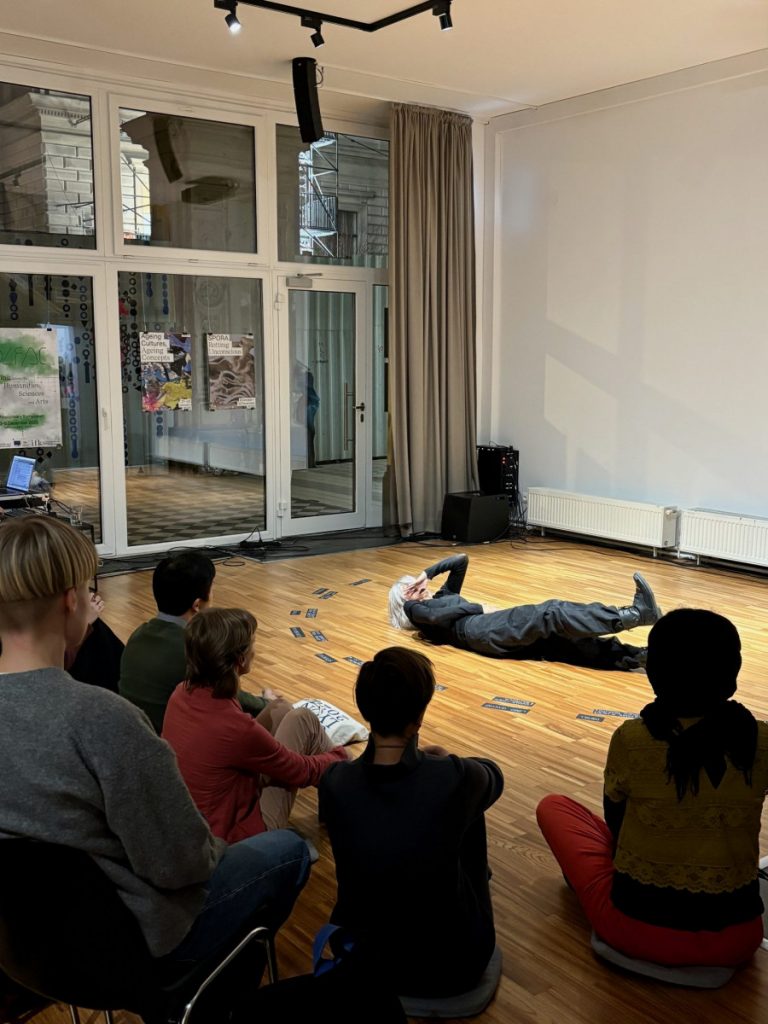
To close the second day, Paola Bianchi and Stefano Murgia (Rimini/Torino) presented WERKSTATT pathosmells, a performance developed during their OLFAC residency. This was the first showing of the choreographic work that has grown out of a months-long reciprocal research exchange between Austria and Italy. Paola and Stefano explored how smell inflect bodily perception and spatial practice through choreographic means. you can read more on the residency here.
Read on for Day 3 in the next post!